
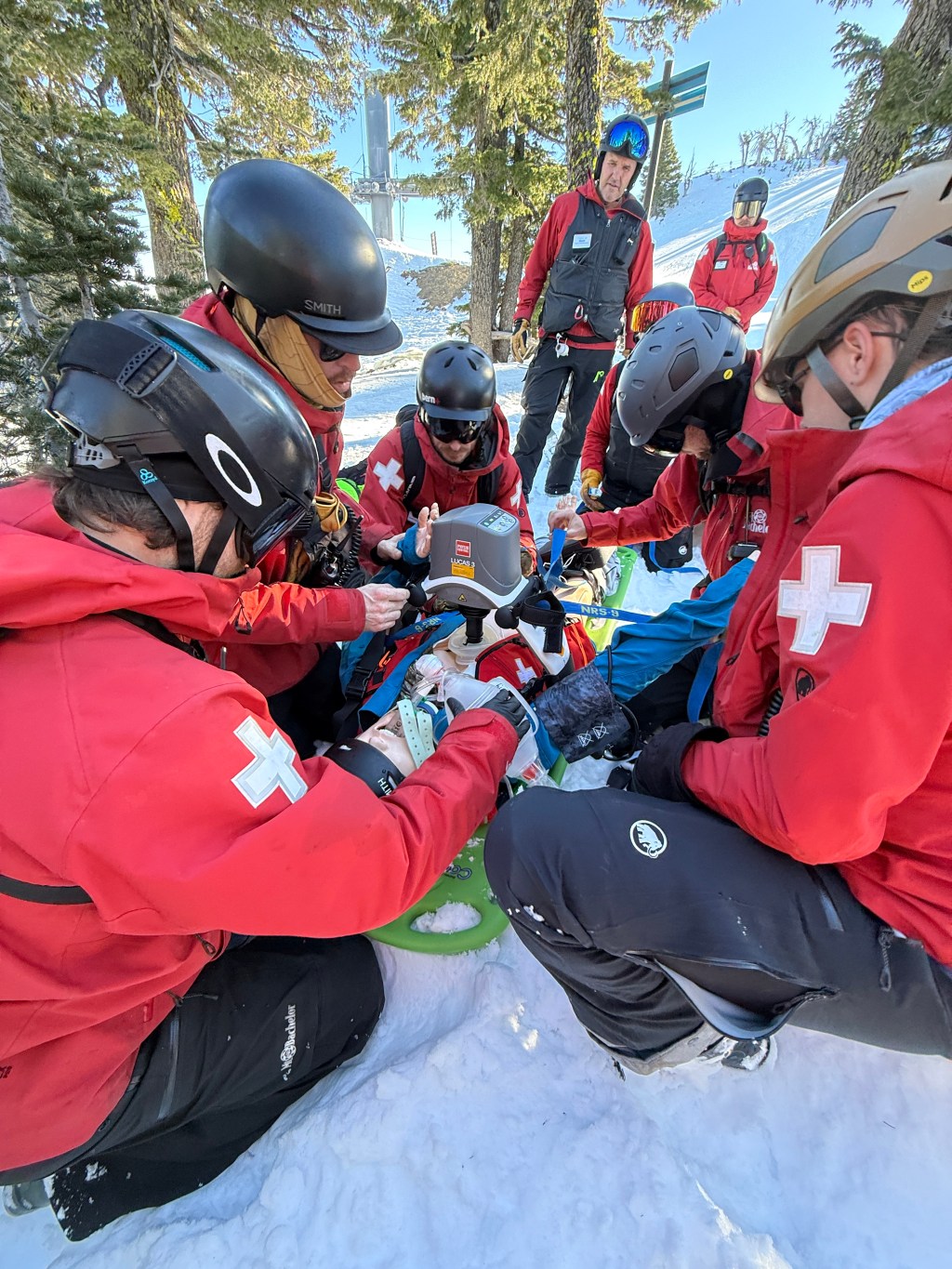
I have a few thoughts that I’d like to share after training and debriefing a pair of code drills yesterday. Watching a drill like that and figuring out how to coach people who are already good so that they can become better is a great challenge, and I’m grateful to work with you all.
Excellence in CPR involves two different ways of looking at a code: the macro, and the micro, the big picture, and the tiny skills.
Overall, the difference between a good code and a bad one can be one person taking charge. If you ever find yourself helping at a code and wondering, “what are we doing? who’s running this?”, that’s a clue. It’s a clue because if you have the bandwidth to be wondering about it, you have awareness of more than just your own task. In fact, you may be the right person to take charge of the scene, or you can at least ask “who’s in charge?” and help to set the code right.
Ideally, the most medically competent and experienced patroller is in charge. That person should be as hands-off as possible, resources permitting. Their job is to see the big picture, set the tone, and help the team have a shared mental model of what they’re doing and why.
“This patient is in cardiac arrest, and we’re going to stay on scene for the next 20-30 minutes to deliver good CPR before we think about moving.”
When they are thinking big picture, it frees up everyone else on scene to think little picture, to think about the micro.
Micro thoughts:
Airway: How’s the position of the head and the jaw? Are an LMA and an NPA making delivering breaths easy enough? Do I need a second person to give a two-handed mask seal? Can I switch to an LMA? Am I giving breaths in a 30:2 or a continuous rate? Is oxygen attached and running?
Compressors: Focus on hard and fast, good recoil, good position. Changing every 2 minutes at pulse checks. Which side of the patient gives better compressions? Is the surface good? or do we need a backboard under the patient?
AED: Is the chest exposed? Are pads in good position and connected? Metronome on? Am I prepared to deliver the shock when instructed? Can I find a femoral pulse during compressions? How does the rhythm look on the monitor?
LUCAS: How is the LUCAS position on the chest? is it in 30:2 mode or continuous? Am I ready to pause when the AED instructs? LUCAS board stable? Hands secured?
This is not to say that you shouldn’t ask questions, point out things that seem off, or lead from the bottom up if you’re part of the pit crew. If you have a question, others probably do too. But if you’re running the AED, don’t worry about which LZ the helicopter is coming to, or who’s on coms. Focus on being excellent in your role, because if all members of the crew are excellent at what they do, then the care delivered will be excellent too.
 Big Mountain Medical